If you have an asphalt shingle roof (which most homes around Naples do), your roof is basically a big protective sandwich.
And the top layer, the part you actually see, is made of tiny little mineral granules.
Those granules are not decoration. They are doing real work every single day in the Florida sun, in the rain, in the salt air. So when people ask, “Is roof cleaning safe?” what they are really asking is this:
Will it mess up my granules?
That’s the whole ballgame.
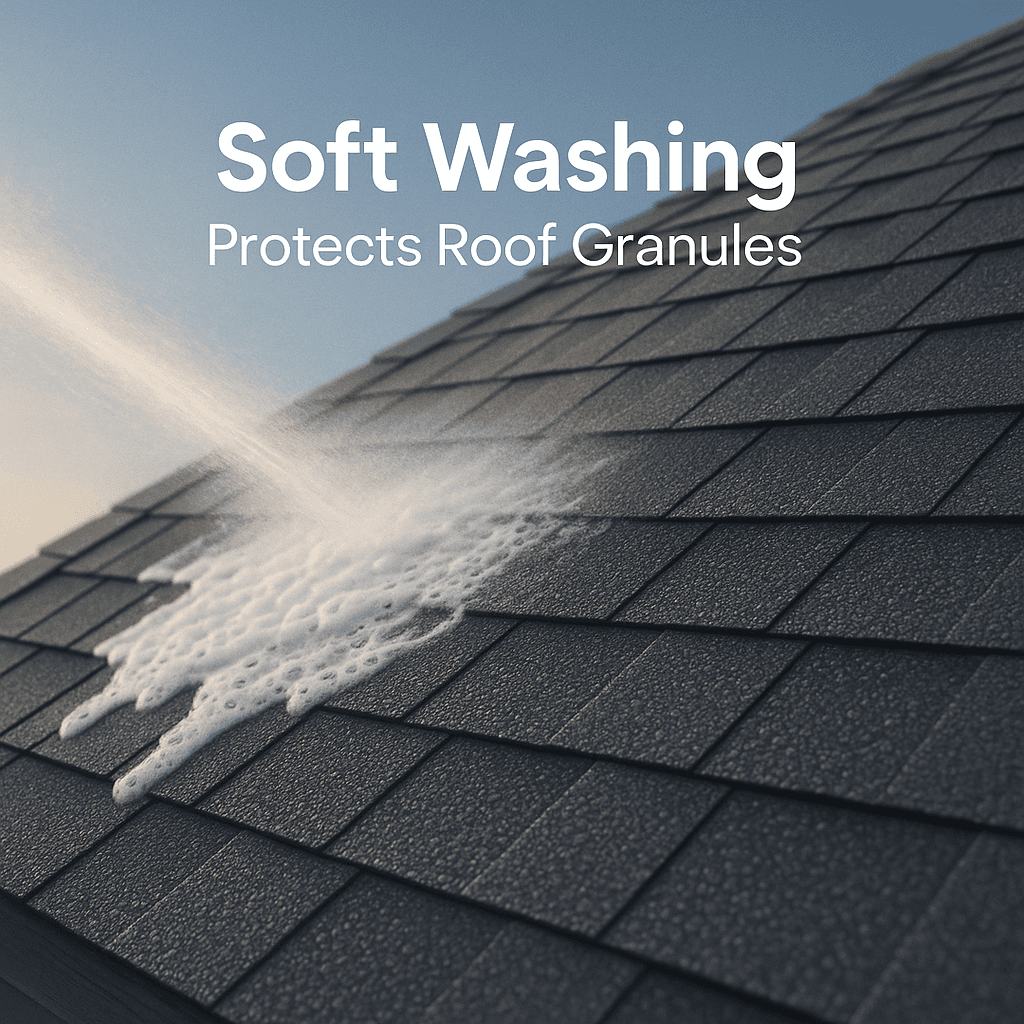
Soft washing, when it’s done correctly, is one of the safest ways to remove the ugly stuff on a roof without blasting off the protective layer that keeps your shingles alive.
In this post I’ll break down what roof granules do, what causes granule loss, why pressure washing is risky, and how soft washing helps protect those granules instead of stripping them away.
Roof granules 101 (what they do and why you should care)
Roof granules are the gritty, sand-like coating on the surface of asphalt shingles. They serve a few big purposes:
- UV protection: They block sunlight from cooking the asphalt underneath.
- Impact protection: They help shingles resist wear from wind-driven debris and light hail.
- Fire resistance: Many granules are designed to improve fire ratings.
- Color and appearance: Sure, they make the roof look uniform. But that’s the least important job.
When granules come off in large amounts, the shingle underneath is exposed. That asphalt dries out faster, cracks sooner, and you start inching toward leaks and early roof replacement.
So a “clean roof” that lost a bunch of granules in the process is… not really a win.
What actually causes granule loss?
Some granule loss is normal. You’ll often see a bit in the gutters over time, especially on a newer roof settling in or an older roof nearing the end of its life.
But the big, avoidable causes tend to be:
1) High pressure cleaning (the obvious one)
A pressure washer can hit shingles hard enough to dislodge granules, loosen the edges of shingles, and drive water where it shouldn’t go. On a hot day, shingles can be softer too, which makes it even easier to damage them.
2) Aggressive scrubbing or harsh mechanical cleaning
Stiff brooms, brushes, “roof rakes” used the wrong way. Same issue. Abrasion.
3) Algae and organic growth that holds moisture
In Naples you see a lot of those dark streaks. That’s usually Gloeocapsa magma, an algae that feeds on the shingle materials and holds moisture. Moss and lichen can do even more damage because they can root into surfaces and retain water.
Even if you never clean the roof, that growth can contribute to deterioration. Not always overnight, but it adds up.
4) Foot traffic and poor walk patterns
Walking on a roof can scuff granules off, especially if you’re not stepping correctly or you’re on brittle shingles.
5) Age and weather
Sun, heat, storms, wind. Granules wear down over the years. Florida roofs get a lot of exposure.
The point is, your roof is already fighting enough. Cleaning should not be another thing that beats it up.
However, it’s important to note that some cleaning methods can actually help maintain your roof’s integrity instead of harming it. For instance, certain cleaning techniques when applied correctly can prevent moss and algae buildup without causing granule loss.
Pressure washing vs soft washing (the core difference)
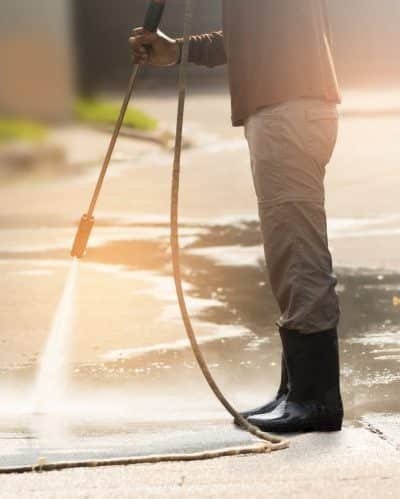
Pressure washing cleans by force. Think blasting.
Soft washing cleans by chemistry. Think soak, kill, rinse gently.
That’s the simplest way to explain it without getting too technical.
Pressure washing on shingles
- Uses high PSI to strip away staining and growth.
- Can remove granules (sometimes instantly, sometimes you notice later in the gutters).
- Can lift shingle edges.
- Can force water under shingles, increasing the chance of leaks.
Soft washing on shingles
- Uses a low-pressure application of a roof-safe cleaning solution designed to kill algae and organic growth.
- The growth dies off and releases from the surface.
- The rinse is typically gentle, meaning you’re not relying on pressure to “scrape” the roof clean.
It’s less like sandblasting a wall. More like treating it and letting the problem let go.
So how does soft washing protect your roof granules?
Here’s what’s really happening, step by step.
1) It avoids the physical abrasion that knocks granules loose
Granules usually don’t come off because something politely touched them. They come off when something scrapes them, hits them, or forces them off.
Soft washing uses low pressure. That means the cleaning isn’t coming from impact.
Less impact = less granule loss.
2) It kills the algae at the root (instead of “ripping the top off”)
Those black streaks are not just surface dirt. They’re living organisms.
Pressure washing can make a roof look clean quickly, but it can leave behind living spores. So the roof darkens again sooner. People re-clean. More cleaning cycles. More wear.
Soft washing is designed to kill the algae, not just remove the discoloration.
That matters for granules because fewer aggressive re-cleans over time generally means less cumulative damage.
3) It reduces moisture retention caused by growth
Algae, moss, and lichen tend to keep the surface damp longer. Damp roofs are more prone to accelerated wear and can contribute to shingle degradation.
When you remove that biological layer, you’re helping the roof dry out more normally after rain.
Granules last longer on a roof that isn’t constantly staying damp in patches.
4) It’s controlled and even (less “spot fixing” damage)
A lot of DIY roof cleaning goes like this:
One ugly streak. Blast it. Scrub it. Blast more. Repeat.
Spot treatment turns into uneven force. That’s where you see random patches of granule loss or shingle scuffing.
A proper soft wash treatment is more uniform and controlled. The roof gets treated as a roof, not as a series of stains to attack.
5) It helps preserve the manufacturer look and texture
Roofs have a texture that’s meant to shed water and handle UV exposure. When granules are stripped, you can end up with shiny areas, bald spots, and inconsistent shingle appearance.
Soft washing, done properly, is meant to restore the roof’s appearance while keeping that gritty protective finish intact.
“But won’t chemicals damage my shingles?”
This is a fair question. It’s also where the phrase “done correctly” matters a lot.
A roof-safe soft wash approach uses the right dilution, proper dwell time, proper application, and a controlled rinse. The goal is to kill growth effectively without turning the roof into a science experiment.
Also, the bigger danger for most roofs is not a properly applied cleaner. It’s mechanical damage from high pressure, aggressive brushing, or repeated harsh cleaning attempts.
If you’re in Southwest Florida and you want a local company that specializes in soft washing (not pressure washing your roof), you can check out Naples Soft Wash Roof Cleaning (Wash and Glow). They focus specifically on soft wash methods and educating homeowners on what’s actually happening up there.
What granule loss looks like (so you can spot issues early)
Sometimes the roof looks “fine” from the driveway, but the early signs show up elsewhere:
- Granules collecting in gutters like coarse sand.
- Downspout discharge that leaves gritty piles after heavy rain.
- Bald spots on shingles where the surface looks smoother or darker.
- Color inconsistency that doesn’t look like staining, more like wear.
If you already have major granule loss because the roof is old, cleaning still might be possible, but it needs to be evaluated carefully. The goal becomes “remove growth safely” not “make it look brand new at any cost.”
Soft washing in Naples specifically (why roofs here get streaky fast)
Naples, Estero, Bonita Springs, Marco Island. The whole area is basically a perfect environment for roof algae:
- Heat
- Humidity
- Frequent rain
- Shaded roof sections from trees
- Coastal air and airborne organics
So you end up with those black streaks that creep down from the top of the roof. And if the roof stays stained for years, homeowners often get tempted to “just pressure wash it.”
That’s usually when the granule problem starts, especially considering that roofs in this region are often made of asphalt shingles, which can be damaged by high-pressure washing.
Soft washing is popular here for a reason. It matches the environment. Kill the organisms, let the roof recover, keep the protective surface intact.
A few images that help explain it (and what to look for)
Here are some visuals you can add to make this easier to understand on-page.
Asphalt shingle close up (granules)
Typical roof algae staining (dark streaks)
A home exterior in Florida climate (context)

If you’d rather use your own before and after photos (honestly best for trust), sprinkle them in the same spots.
What to ask before you hire anyone to clean your roof
If you want to protect your granules, ask simple questions. The answers tell you everything.
- Are you soft washing the roof, or pressure washing it?
If the answer is “pressure, but not too much” be careful. - What PSI hits the shingles?
Soft wash roof cleaning should not be relying on high PSI to do the work. - Do you walk on the roof? If so, how do you minimize scuffing?
Sometimes walking is necessary. The key is how it’s done. - How long should the roof stay clean?
A good process is about killing growth, not just rinsing stains.
(Wash and Glow advertises a 2 year clean guarantee, which is the kind of thing you want to look for because it signals confidence in the method, not just the “day of” results.) - Do you protect landscaping and rinse everything after?
A professional setup includes controlled runoff and proper rinsing.
The simple takeaway (and what to do next)
Roof granules are the shield that keeps your shingles from baking and breaking down. If you remove the granules, you shorten the roof’s life. Full stop.
Soft washing protects granules mainly because it avoids aggressive force. It treats the biological cause of staining and growth, lets it release naturally, and keeps the roof’s gritty protective layer where it belongs.
If you’re in Naples or nearby and you want a quote or just want to see how the process works, you can visit softwashroofcleaningnaples.com and get a fast estimate from Naples Soft Wash Roof Cleaning (Wash and Glow). Even if you don’t book right away, it’s a solid starting point to understand what safe roof cleaning should look like.
FAQs (Frequently Asked Questions)
What are roof granules on asphalt shingle roofs and why are they important?
Roof granules are tiny, sand-like mineral coatings on asphalt shingles that serve several key purposes: they provide UV protection by blocking sunlight to prevent the asphalt from cooking, offer impact resistance against wind-driven debris and light hail, improve fire resistance, and contribute to the roof’s color and appearance. Losing these granules exposes the asphalt beneath, causing it to dry out, crack sooner, and potentially lead to leaks and early roof replacement.
What causes granule loss on asphalt shingle roofs?
Granule loss can occur naturally over time as a roof ages, but avoidable causes include high-pressure cleaning methods that blast off granules, aggressive scrubbing or harsh mechanical cleaning with stiff brushes or roof rakes, algae and organic growth like Gloeocapsa magma that hold moisture and degrade shingles, improper foot traffic on brittle shingles, and weather-related wear such as sun exposure, heat, storms, and wind common in Florida.
Is pressure washing safe for cleaning asphalt shingle roofs?
Pressure washing is generally risky for asphalt shingle roofs because it uses high PSI force that can dislodge granules instantly or over time, lift shingle edges, and drive water under shingles leading to leaks. While it may remove stains quickly, it can damage the protective layer of the roof and accelerate deterioration.
How does soft washing differ from pressure washing for roof cleaning?
Soft washing cleans by using low-pressure application of specialized roof-safe cleaning solutions that kill algae and organic growth chemically rather than by force. After soaking the contaminants to kill them at the root, a gentle rinse removes them without physically scraping or blasting the roof surface. This method minimizes abrasion and protects the vital granule layer on shingles.
Why is soft washing considered safer for preserving roof granules during cleaning?
Soft washing avoids physical abrasion that knocks granules loose by relying on low pressure instead of high-impact blasting. It kills algae and organic growth at their roots rather than merely removing surface stains, preventing quick regrowth and reducing the need for frequent cleanings. This gentler approach helps maintain the integrity of the protective granule layer essential for a long-lasting roof.
Can algae and organic growth harm my asphalt shingle roof if left untreated?
Yes. Algae such as Gloeocapsa magma feed on shingle materials while holding moisture against the surface. Moss and lichen can root into shingles and retain water longer. This moisture retention accelerates deterioration by promoting cracks and decay over time. Even without cleaning damage, unchecked organic growth contributes significantly to premature roofing problems in humid climates like Naples.