
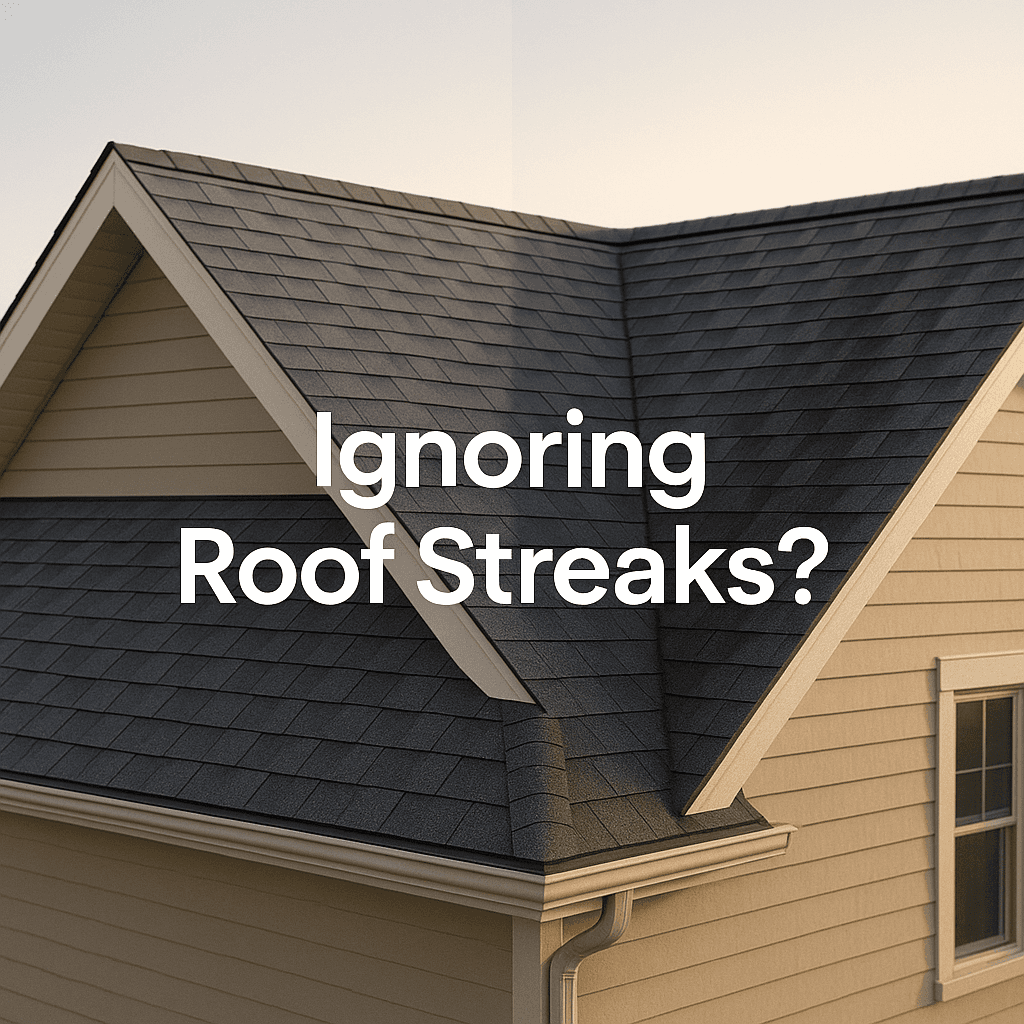
What Happens If You Ignore Roof Streaks in Naples FL — The 10-Year Damage Timeline, the $15K–$45K Replacement Math, and Why “It’s Just Cosmetic” Is the Most Expensive Sentence in Florida Roofing.
|
B
|
By Blane · Owner · Wash and Glow
11+ Years Naples · Published March 16, 2026 · Updated May 2026
|
After 11+ years and 8,000+ Naples cleanings, the question I get most often from homeowners who’ve been deferring maintenance for years is: “What actually happens if I just leave the streaks alone?” The honest answer has two parts. First: the streaks themselves are biology, but the damage they cause over 5–10 years is structural — substrate erosion, granule loss on shingle, glaze damage on tile, and accelerated material aging. Second: the cumulative cost of ignoring streaks for a full 10-year cycle on a Naples roof is typically in the $15K–$45K range when premature replacement enters the math — versus $349–$649 per cleaning every 18–36 months for the same period.
This piece is the version of the answer I’d give you on a walkthrough quote when you’re trying to decide whether the streaks really matter. The damage timeline by year, the specific structural failures that follow biology, the insurance and HOA consequences, and the four scenarios where deferring genuinely doesn’t matter (yes, there are some).
Years 4–6: Visible Streaks Become Substrate Damage — The Point Where Cleaning Stops Being Sufficient
By year 4–6 of untreated biology, Gloeocapsa cyanobacteria has penetrated the roof surface at root depth and is producing acidic byproducts that erode tile glaze, shingle binder, and metal coatings. Visible streaks are no longer just cosmetic — they’re surface markers for substrate damage underneath. This is the inflection point: clean a roof in year 5 and the cleaning restores both appearance and protection. Wait until year 8 and the cleaning restores appearance but the substrate damage is permanent — the roof clock is now running on a shortened timeline. Spanish tile glaze that should last 50+ years gets compromised at year 8 and starts failing at year 15. Concrete tile that should last 40+ years starts spalling at year 20. Shingle that should last 25 years loses granules at year 12 and fails at year 18. Best for: the math — cleaning at year 4 prevents 10–15 years of premature material aging. Cleaning at year 8 doesn’t undo the damage but stops further progression. Skipping cleaning entirely produces premature replacement at $15K–$45K depending on roof material and home size.
Years 1–3: Cosmetic Surface Streaking — Reversible With Standard Cleaning
Years 1–3 of untreated biology produce visible streaking but no substrate damage. The biology lives on the surface, the cleaning chemistry kills it at root depth, and the roof returns to factory-new condition with no permanent change. Best for: the recurring annual maintenance cycle — customers who clean every 18–36 months stay permanently in this band and never enter the substrate-damage years. The maintenance cycle is what prevents the expensive failure mode entirely.
Years 7–10: Insurance Non-Renewal Territory — Florida Carriers Now Decline Coverage
By year 7–10 of untreated biology, the Florida insurance carrier conversation enters the picture. Post-2024 the carrier market has tightened dramatically and aerial roof imagery is now standard underwriting practice — carriers see the biology in satellite views and either non-renew or require remediation. Carrier non-renewal in Naples post-2024 means scrambling to find replacement coverage in a hard market, often at 30–80% higher premiums even when coverage is available. The cost of carrier non-renewal alone (premium increase + potential coverage gaps) typically exceeds $5K over a 5-year period. Detailed carrier-by-carrier context on our main roof cleaning anchor page. Best for: customers approaching policy renewal with deferred maintenance — the cleaning + documentation packet often resolves the carrier conversation before non-renewal happens.
Years 10+: Premature Replacement on the Horizon — The $15K–$45K Math Activates
Past year 10 of untreated biology, the cumulative substrate damage starts producing visible failure modes — tile glaze pitting, shingle granule loss patches, metal coating breakdown. Roof life expectancy shortens by 5–15 years compared to a maintained roof. Replacement timing pulls forward from year 25–30 (normal) to year 18–22 (deferred maintenance). For a typical 2,500–3,500 sqft Naples concrete tile home, replacement runs $25K–$45K. For Spanish or clay tile $35K–$65K. For asphalt shingle $15K–$28K. The deferred-maintenance math: 10 years of skipped cleanings saves roughly $2K–$4K (5 cleanings at $400–$800 each). 10 years of substrate damage costs $15K–$45K in premature replacement. The ROI on consistent maintenance is roughly 5–15x.
Honest framing: there are scenarios where deferring cleaning genuinely doesn’t matter much, and I want to be straight about which ones.
Exception 1: Selling within 12–18 months. If you’re listing the property and the new owner inherits the roof, your cumulative damage exposure is capped. Pre-listing curb appeal cleaning is the right move (buyer concession math is brutal on visible staining), but you don’t need to commit to a 5-year maintenance cycle.
Exception 2: Roof scheduled for replacement within 24 months. If the roof is already past 20 years old and you’re budgeting replacement in the next 1–2 years, additional cleanings provide minimal ROI. The replacement is happening regardless.
Exception 3: New construction under 4 years old. Roofs in years 1–3 of biology accumulation can be cleaned every 24–36 months instead of every 18–24 — the substrate damage clock hasn’t started yet. The honest framing on new builds is that you have flexibility on cleaning frequency that older properties don’t.
A note from Blane, owner
BLANE · OWNER · (239) 384-0208 · 11+ YEARS NAPLES SPECIALTY

“The honest framing on the 'it's just cosmetic' question is that the streaks themselves are cosmetic — but the damage they cause over 5–10 years isn't. Florida UV is brutal on roof materials and biology accelerates that aging significantly. Customers who run the recurring maintenance cycle every 18–36 months stay permanently in the cosmetic-only band and the roof lasts its full design life. Customers who defer for 8+ years end up paying for premature replacement that wouldn't have been needed otherwise. The math is favorable on cleaning maintenance by 5–15x — it's the highest-ROI maintenance category on a Naples home. The exception is if you're selling soon or the roof is already at end-of-life. Otherwise the cleaning cycle pays for itself in extended roof life and prevented insurance hassle.”
— Blane, owner · answers the phone personally

Want to know what year of the damage timeline your roof is actually in?
Walkthrough quote includes biology load assessment, substrate damage check, and an honest read on whether you’re in the cosmetic-only band or starting to enter the substrate-damage years. Call or text the same number.
| ☎ Call (239) 384-0208 | 💬 Text Same Number |