
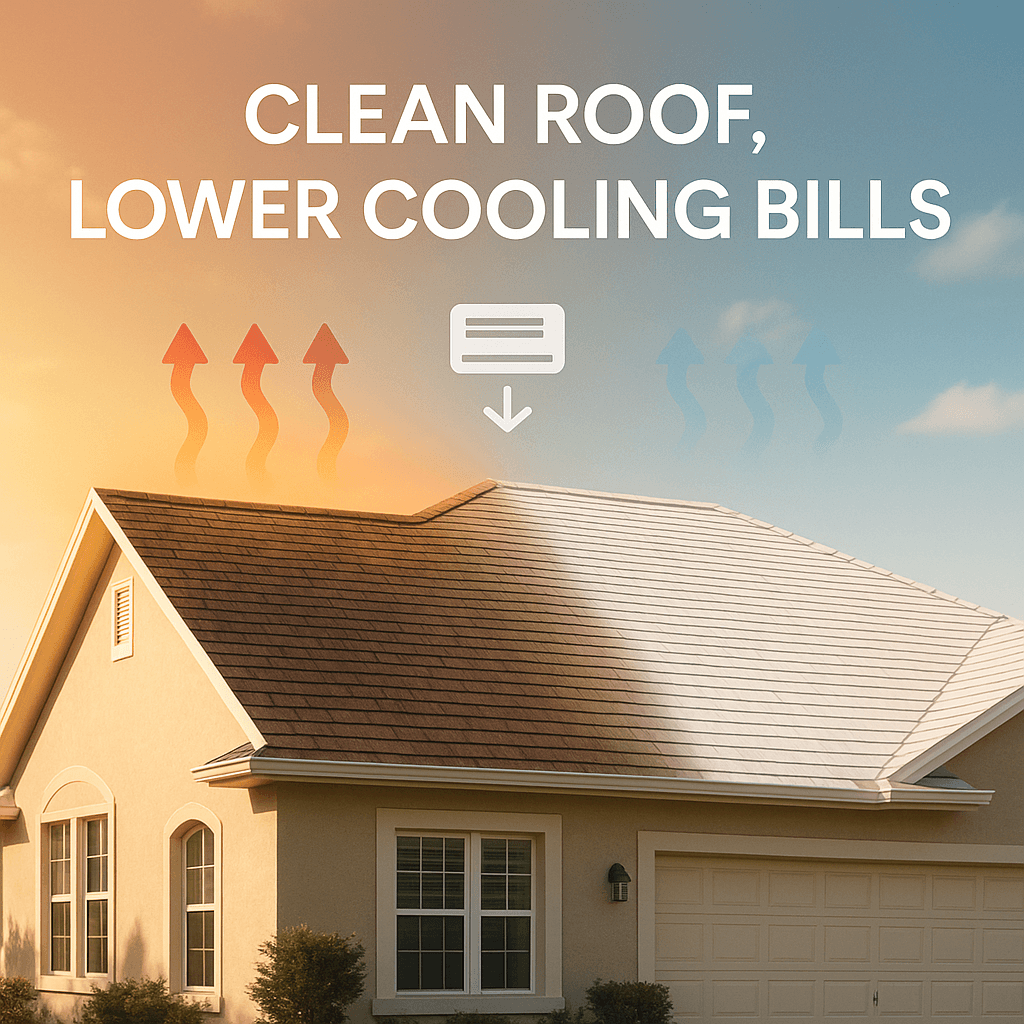
Does Roof Cleaning Lower Cooling Bills in Florida? — The Honest Answer After 11+ Years — Yes, By 5–12% on Affected Roofs, and the Specific Conditions Where the Math Works.
|
B
|
By Blane · Owner · Wash and Glow
11+ Years Naples · Published March 18, 2026 · Updated May 2026
|
After 11+ years and 8,000+ Naples cleanings, the question I get most often from data-minded homeowners is: “Is the cooling-bill savings argument actually real, or is that just marketing?” The honest answer has two parts. First: the savings are real but conditional — 5–12% reduction on roofs with significant biology load and dark-colored surfaces, essentially zero on roofs without those conditions. Second: the cooling-bill savings should not be the primary reason you clean a roof. The primary reason is biology damage prevention; cooling savings are a secondary benefit that pays back on some properties and not others.
This piece is the version of the answer I’d give you if you handed me your last 12 FPL bills during the walkthrough. The physics of why dark-stained roofs run hotter, the specific roof conditions where savings are measurable, the conditions where they aren’t, and why marketing material claiming “up to 30% energy savings” is doing math wrong on purpose.
Gloeocapsa Magma cyanobacteria produce a dark UV-protective pigmentation as a survival mechanism against intense Florida sun. The dark streaks visible on Naples concrete tile roofs are pigmented colonies absorbing solar radiation and converting it to surface heat. A clean light-colored concrete tile roof might have an albedo (solar reflectance) of 0.30–0.50 — reflecting 30–50% of incoming solar radiation. The same roof streaked with mature Gloeocapsa drops to albedo 0.15–0.25 — reflecting half as much. The absorbed difference becomes attic heat, which becomes HVAC load, which becomes cooling cost on your FPL bill.
The math gets complicated by attic insulation, ductwork condition, HVAC equipment efficiency, and home thermal mass. Properties with poorly-insulated attics and ductwork in the attic space (common in older Naples homes) see the largest cooling-bill reductions from roof cleaning because more of the absorbed roof heat is transferring into conditioned air. Properties with R-30+ blown insulation and ductwork inside the conditioned envelope see smaller reductions because the thermal pathway from roof to air handler is broken.
Real-world data from our recurring customer base: cooling bills before and after roof cleaning for HNW Naples properties with mature roof biology and attic-routed ductwork show 7–11% reduction in summer-month FPL costs (June through September). Properties with newer construction, R-38+ insulation, and conditioned-space ductwork show 0–3% reduction — the savings exist but they’re inside the noise floor of normal monthly variation. The 5–12% range is honest. The “up to 30%” range some operators advertise is fake — it’s the maximum theoretical reduction in a worst-case scenario nobody actually has.
Older Naples Property + Mature Biology Load + Attic-Routed Ductwork
The savings sweet spot. Property 15+ years old (likely R-19 or lower attic insulation, original ductwork routed through unconditioned attic space). Roof showing 4+ years of biology accumulation with mature Gloeocapsa streaking covering 40%+ of visible surface area. Concrete or Spanish tile roof in original color (terra cotta, gray, brown). On these properties, post-cleaning cooling-bill reduction runs 8–12% during summer months — typically $40–$120 per month savings depending on home size and HVAC load. The cooling savings alone often pay for the cleaning service within 18–24 months. Best for: homeowners in older Naples gated communities (Pelican Bay, Vanderbilt Beach, Coquina Sands, Park Shore), older Estero properties (Country Creek, original Bella Terra), and Marco Island properties with original 1970s–1990s construction. The cooling math compounds with the biology damage prevention to make the maintenance cycle self-funding.
Mid-Age Naples Property + Moderate Biology Load + Mixed Insulation
The middle band. Property 8–15 years old, biology load showing but not yet mature (2–3 years since last cleaning, surface knockdown visible to professional eye but not screamingly obvious to homeowner). Insulation typically R-30 with some attic-routed ductwork, some conditioned-space. Cooling savings run 4–7% during summer — typically $20–$60 per month savings. Real but smaller, and inside the band where normal monthly variation can mask it. The math still works — just slower payback. Best for: homeowners doing recurring annual maintenance who measure year-over-year FPL costs alongside the visual roof improvement. The cooling savings show up clearly in 12-month rolling averages even when individual monthly bills swing within normal variance. Detailed pricing context on our house wash transparent pricing page.
New Construction + Light Biology + R-38+ Insulation + Conditioned-Space Ductwork
The honest band. Property under 8 years old, light biology load (annual maintenance customer or recently-built), R-38+ blown attic insulation, ductwork inside conditioned envelope. Cooling savings 0–3% — inside the noise floor of normal monthly variance, essentially unmeasurable. Don’t make cooling savings the primary justification for cleaning these roofs — the justification is biology damage prevention (Gloeocapsa root depth penetration causes tile substrate damage over 10+ years regardless of cooling impact) and HOA aesthetic compliance, not FPL bill reduction. Best for: communities like Verdana Village, Tidewater by Del Webb Estero, recent Mediterra phases, Quail West — newer construction where the cleaning-cycle ROI math is biology damage and HOA compliance, not cooling savings.
The math behind the inflated claim: studies cited in the “30% savings” marketing typically test extreme scenarios — dark-asphalt roofs converted to highly-reflective cool roofs with white coating, properties with 1970s-grade R-11 insulation and exposed ductwork, properties in climates with extreme cooling loads. None of those conditions are typical Naples residential. Translating those study results to a routine soft wash cleaning on a typical Naples concrete tile roof is intellectually dishonest.
The honest framing: 5–12% on the right properties, 0–3% on properties where it doesn’t move the needle. If an operator is leading with cooling-bill savings as the primary value prop, they’re either misunderstanding the physics or marketing aggressively. The primary value prop on roof cleaning is biology damage prevention and aesthetic compliance — cooling savings are a real but secondary benefit that varies by property profile.
A note from Blane, owner
BLANE · OWNER · (239) 384-0208 · 11+ YEARS NAPLES SPECIALTY

“On the cooling-bill question, my honest framing is that I won't pretend the savings are bigger than they are because I want you to feel better about the cleaning service. The savings are real on the right properties — older homes, mature biology load, attic-routed ductwork — and they're essentially zero on newer construction with good insulation. If you're in the first category, the cooling savings often cover the cleaning cost within 18–24 months and the maintenance cycle is self-funding. If you're in the second category, the right reason to clean your roof is biology damage prevention and HOA compliance, not FPL bill reduction. The walkthrough quote should include an honest assessment of which category you're in based on the home age, attic visibility, and current biology load. Anyone promising 30% energy savings on a routine cleaning is selling you marketing, not math.”
— Blane, owner · answers the phone personally


Want an honest cooling-savings estimate for your specific property?
Walkthrough quote includes property profile assessment (age, biology load, insulation visible from attic) and an honest savings range. No 30% promises. Call or text the same number.
| ☎ Call (239) 384-0208 | 💬 Text Same Number |