
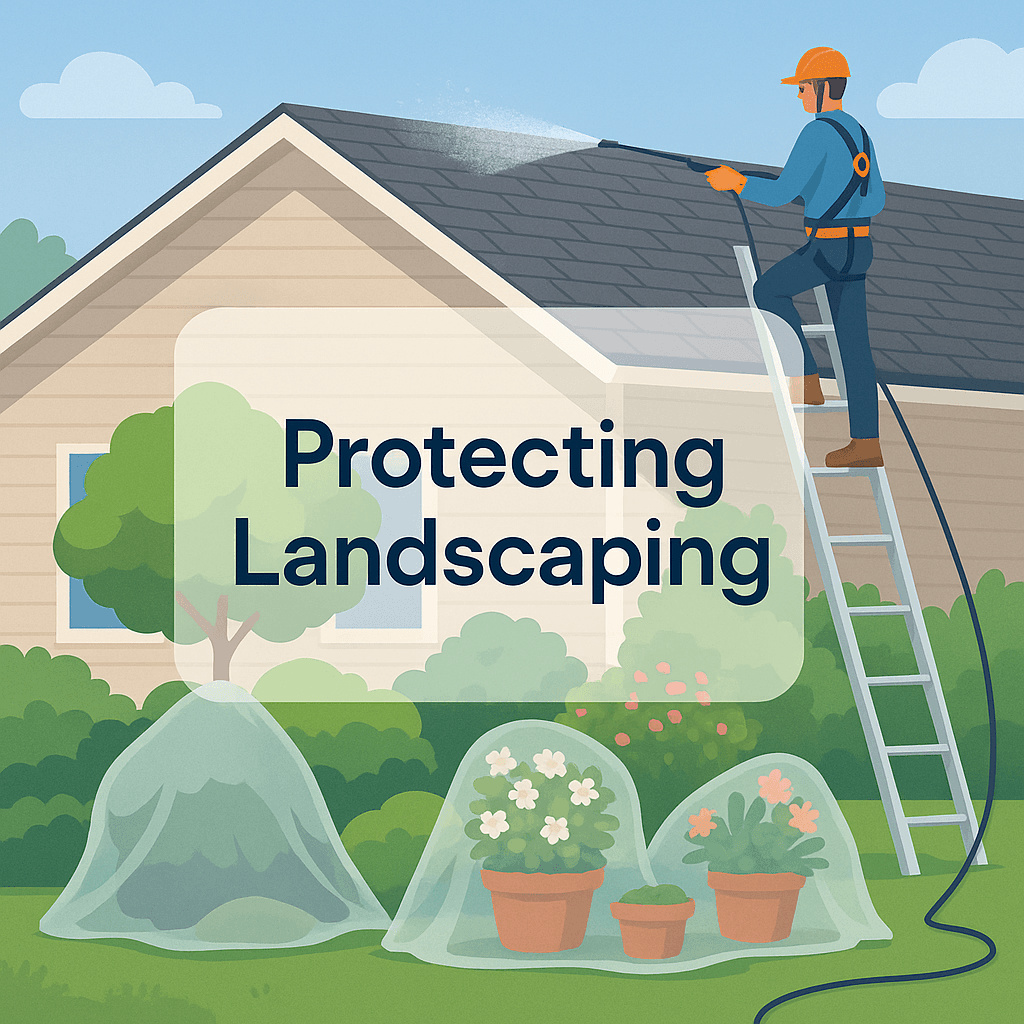
Protecting Naples Landscaping During Roof Cleaning — The Six-Step Protocol That Keeps Bromeliads, Bougainvillea, and Foxtail Palms Alive Through 8,000+ Cleanings (And Why “We Don’t Worry About Plants” Is the Honesty Test).
|
B
|
By Blane · Owner · Wash and Glow
11+ Years Naples · Published March 20, 2026 · Updated May 2026
|
After 11+ years and 8,000+ Naples roof cleanings, the question I get most often from gated-community homeowners with mature landscaping is: “What’s actually going to happen to my bromeliads and bougainvillea while you’re up there with bleach?” The honest answer has two parts. First: we use sodium hypochlorite chemistry on the roof and yes, undiluted contact with foliage will damage plants. Second: the six-step protection protocol that’s been industry standard for 30+ years prevents that contact entirely — and we’ve never had a mature established plant loss across 8,000+ cleanings when the protocol runs correctly.
This piece is the version of the answer I’d give you on a walkthrough quote standing next to your foundation hibiscus. The six steps in order, what each step accomplishes, the test question that distinguishes operators who actually run the protocol from operators who skip steps, and the four scenarios where you should walk away from a quote regardless of price.
Naples gated-community foundation landscaping is mostly subtropical specimens running peak photosynthesis 12 months per year: bromeliads, cordyline, ti plant, hibiscus, ixora, plumbago, foxtail palm, queen palm, areca palm, ornamental grasses. These plants are in active growth mode every month — there’s no dormancy window when they’re more chemistry-tolerant. They’re also typically planted in raised foundation beds with sandy well-draining soil, which means runoff from the roof drips directly into the root zone unless we manage it actively.
Sodium hypochlorite (the active biocidal chemistry in soft wash) damages plant tissue by oxidizing chlorophyll on leaf surfaces and disrupting cell membranes at root zone level. The damage threshold depends on concentration, contact time, and plant tissue moisture content. The protocol works by attacking all three variables simultaneously: we dilute concentration before contact (pre-wet), we eliminate direct contact entirely (cover), we shorten contact time when contact does occur (active rinse during dwell), and we increase tissue moisture saturation so any chemistry that lands hits already-saturated tissue and runs off rather than being absorbed (continuous pre-wet maintenance through the job).
The reason “we’ve never had a plant loss” isn’t that we use special chemistry. It’s the same sodium hypochlorite working solution every operator uses. The difference is operational discipline on the protocol — every step, every job, regardless of whether the homeowner is watching or not. Operators who skip pre-wet because the homeowner isn’t asking about it, or who skip post-rinse because they’re trying to get to the next job, are the operators with plant-loss claims on file.
Step 2: Pre-Wet All Landscaping (15–20 Minutes Before Chemistry Touches the Roof)
Pre-wet is the single non-negotiable step. Before any chemistry leaves the wand, we saturate every plant within the drip line of the roof and every plant within the runoff path. The garden hose runs continuously for 15–20 minutes — not a quick spray, a thorough soak that saturates leaf tissue, soaks through the canopy of larger plants, and saturates the top 4–6 inches of soil in the foundation beds. What this accomplishes: any chemistry that contacts a pre-wet plant lands on already-saturated tissue, which means the chemistry is immediately diluted to roughly 10–20% of its as-applied concentration before it can do tissue damage. Pre-wet soil also means runoff entering the soil hits a saturated boundary and flows through rather than being absorbed at concentration. Best for: every job, no exceptions — the test question for any operator quoting your job is “how long do you pre-wet?” If the answer is “a quick spray” or “we just hose down the bushes” that operator is going to damage your plants. The right answer is “15–20 minutes minimum, longer for properties with extensive foundation planting.”
Step 1: Site Walk and Sensitive-Item Assessment (Before Any Equipment Setup)
Before any hose unrolls, we walk the property perimeter and identify everything that needs protection beyond standard pre-wet. Specimen plants we cover with sheeting (rare bromeliads, orchids on display, recently-planted specimens still in establishment phase). Water features we cover or actively pump fresh water through during the job (koi ponds, lily ponds, ornamental fountains). Pool equipment we cover and isolate (pumps, heaters, automation panels, salt cells, exposed electrical). AC condenser fins we note and route work around. Outdoor furniture cushions and fabric items we move indoors. Vegetable gardens and herb beds get sheeting plus extended pre-wet. We also confirm with the homeowner anything we missed. Best for: properties with anything beyond standard foundation planting — koi pond owners, orchid collectors, vegetable gardeners, anyone with rare or recently-installed specimens. The site walk catches what generic protocol misses.
Step 3: Cover Pool Equipment, Specimen Plants, Sensitive Surfaces
Weighted plastic sheeting on specimen plants in heavy chemistry zones. Plastic-bag-and-tape covering on AC condenser fins. Custom-cut tarp covering on pool equipment cabinets. Fabric or cardboard covering on outdoor furniture cushions. The cover phase is straightforward but it’s the step that operators most commonly shortcut — they’ll pre-wet but skip the cover step because cover takes more time per job. Best for: the pool equipment piece is critical even on minimal-landscape properties — sodium hypochlorite contact with copper coils, salt cells, or exposed electrical components causes damage that’s expensive to repair and out of scope for any roof cleaning warranty. The covering protects the homeowner’s pool equipment investment, not just the operator’s liability.
Steps 4 & 5: Apply Chemistry, Manage Runoff Pathways, Continue Pre-Wet During Dwell and Rinse
Chemistry application happens at 50–100 PSI through extension wands. During the 15–30 minute dwell, we don’t just stand around — we actively manage runoff pathways from the roof to the ground. If we see chemistry draining toward a particularly vulnerable plant we immediately dilute that drainage path with fresh water. We continue pre-wetting foundation landscaping every 5–10 minutes through the entire dwell-and-rinse phase to maintain tissue saturation. The roof rinse phase generates the largest volume of chemistry-contact water reaching the ground, so we distribute the rinse across multiple drainage paths rather than concentrating it on one downspout location. Best for: the plant-monitoring discipline matters most on properties with valuable specimens directly under roof drip line — we’d rather take an extra 5 minutes of active management than skip it and risk the bromeliad cluster the homeowner spent four years training.
Step 6: Post-Rinse All Landscaping + Optional Sodium Thiosulfate Neutralizing Application
After roof rinse completes, we run a complete cleanwater rinse over every plant and every foundation bed that received any chemistry contact or runoff. Typically 15–20 minutes of additional rinse time. For properties with particularly sensitive plantings (recently-installed specimens, rare orchids, koi ponds with adjacent foundation beds, vegetable gardens) we follow with a sodium thiosulfate neutralizing application that actively reduces residual sodium hypochlorite concentration in the soil faster than natural degradation would. The neutralizer is photographic-grade chemistry, used in the exact concentration that aquarium keepers use to dechlorinate water before adding fish — it’s safe for everything in the foundation beds and it’s the final insurance layer on the protocol. Best for: specifically request the neutralizing application for properties with koi ponds, vegetable gardens, recently-installed specimens, or any landscape investment significant enough that the extra 10 minutes of operator time is worth peace of mind.
Question 1: “How long do you pre-wet?” Right answer: 15–20 minutes minimum, longer for extensive foundation planting. Wrong answer: “a quick spray” or “we hose down the bushes” or “we use plant-friendly chemistry so we don’t need to.” There is no plant-friendly sodium hypochlorite chemistry. The protocol is what makes it safe.
Question 2: “What do you cover specifically?” Right answer: pool equipment cabinets, AC condenser fins, specimen plants, water features, outdoor furniture cushions, vegetable gardens. Wrong answer: “we don’t really need to cover anything because the chemistry is mild.”
Question 3: “Do you do a post-rinse and is it included in the price?” Right answer: yes, 15–20 minute cleanwater rinse on all foundation landscaping after roof rinse, included in standard quote. Wrong answer: “that’s an upgrade” or “we don’t usually do that on residential.” Post-rinse is part of the protocol, not an add-on.
The protocol is industry standard — it’s not proprietary, it’s not exclusive to Wash and Glow. Any competent Naples roof cleaning operator should be running it. The four warning signs that tell you the operator isn’t:
1. They Tell You Pre-Wet Isn’t Necessary Because Their Chemistry Is “Plant-Safe”
This is the single most common red flag. Sodium hypochlorite is sodium hypochlorite — there’s no plant-friendly version of bleach chemistry. Operators who claim a “plant-safe formula” are either lying about what’s in the working solution, or they’re using a working solution so weak it won’t actually kill the cyanobacteria. Either way, walk.
2. They Won’t Itemize the Protocol Steps in the Quote
The quote should explicitly list site walk, pre-wet duration, cover items, dwell monitoring, post-rinse duration. If the operator’s response is “we just take care of it, you don’t need to worry about the details” — that’s the operator who’s going to skip steps when nobody’s watching. Itemized protocol steps are accountability, not bureaucracy.
3. The Quote Is 30%+ Below Market and the Job Will Take Less Than 90 Minutes
Standard residential roof cleaning runs 2–4 hours when protocol is followed correctly — site walk plus pre-wet plus cover plus application plus dwell plus rinse plus post-rinse plus cleanup. An operator quoting a sub-90-minute job is either skipping protocol steps or using sub-spec chemistry. The pricing math tells the whole story — detailed pricing context on our house wash transparent pricing page.
4. They Won’t Provide References on Properties with Comparable Landscaping
Ask specifically: “Do you have references on properties in [Pelican Bay / Grey Oaks / The Brooks / wherever] with mature foundation planting?” The operator who runs the protocol will have those references. The operator who doesn’t will pivot to general references or claim they can’t share customer info. The customer base is the proof of the protocol.
A note from Blane, owner
BLANE · OWNER · (239) 384-0208 · 11+ YEARS NAPLES SPECIALTY

“The honest framing on plant protection is that it's not the chemistry that's the variable — every operator in Naples uses essentially the same sodium hypochlorite working solution. What's variable is whether the operator actually runs the protection protocol every job, or whether they cut steps when the homeowner isn't watching. Across 8,000+ jobs in Naples we've never had a mature plant loss because the protocol runs the same way every job, regardless of customer presence, time pressure, or job size. The operators who have plant-loss claims on file aren't using different chemistry — they're skipping pre-wet on jobs where the homeowner left for the morning, or they're skipping post-rinse on jobs where they're trying to get to the next stop. The protocol is the differentiator, not the products. Ask the test questions during the quote walkthrough. The operator who answers them confidently and itemizes the steps in writing is the operator who's going to protect your bougainvillea.”
— Blane, owner · answers the phone personally
Want to see the protocol in writing before you book?
The walkthrough quote includes itemized protocol steps in writing. Pre-wet duration, cover items, post-rinse duration, optional neutralizing application. No ambiguity, no hidden upgrades. Call or text the same number.
| ☎ Call (239) 384-0208 | 💬 Text Same Number |