
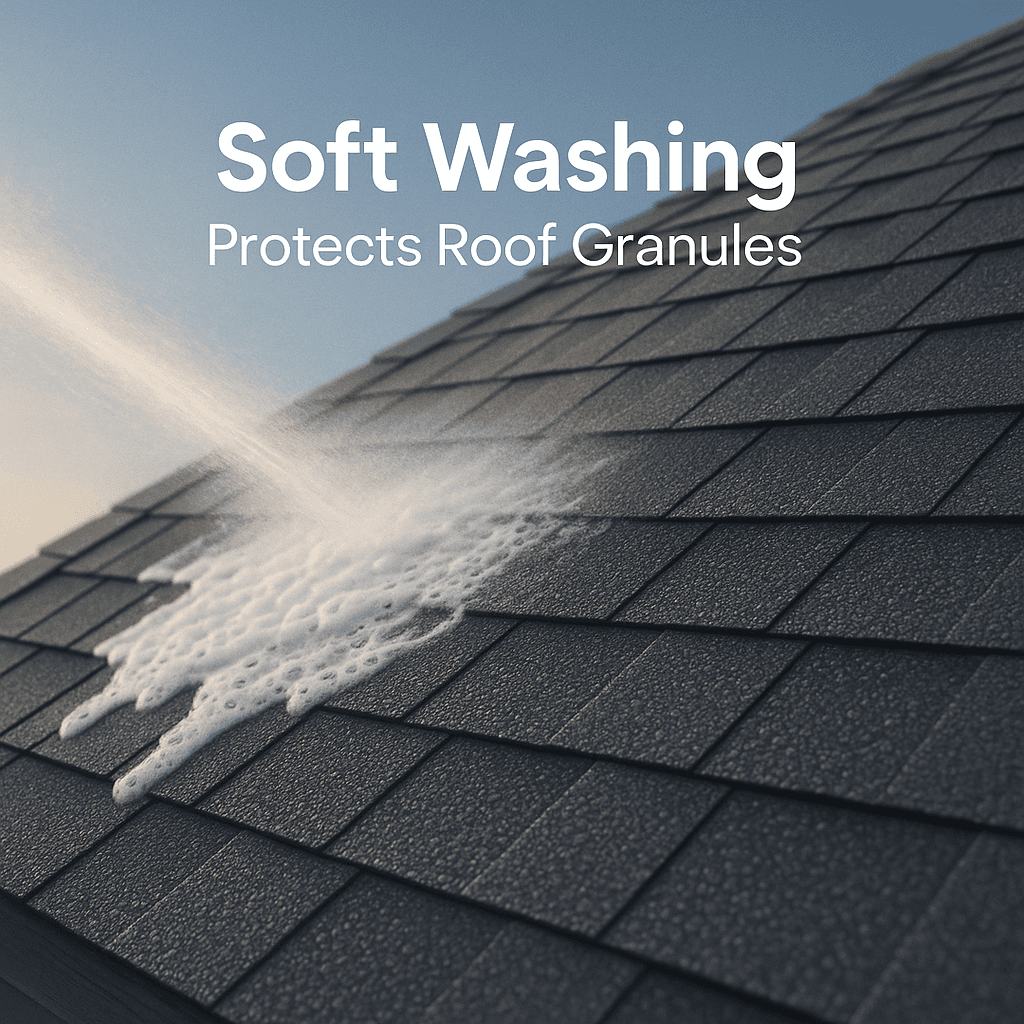
How Soft Washing Protects Roof Granules — The 50 PSI Spec Most Operators Ignore, the Granule Loss Math Insurance Adjusters Now Track, and Why Pressure Washing Is the Wrong Answer to Biology.
|
B
|
By Blane · Owner · Wash and Glow
11+ Years Naples · Published March 4, 2026 · Updated May 2026
|
After 11+ years and 8,000+ Naples cleanings, the question I get most often from shingle-roof homeowners is: “Will the cleaning damage my granules?” The honest answer has two parts. First: proper soft wash protocol uses 50 PSI rinse pressure (about the same as a garden hose) which is engineered specifically to NOT dislodge granules. Second: pressure washing at 1500–3000 PSI absolutely will damage granules — which is why ARMA (Asphalt Roofing Manufacturers Association) prohibits pressure washing on shingle roofs.
The 50 PSI spec, the granule loss math, the warranty implications, and why “power washing” your shingle roof is the wrong answer to biology.
Soft Wash Application + Rinse Runs at 50 PSI — Below the Threshold That Dislodges Granules
Proper soft wash equipment delivers chemistry application and rinse at 50 PSI, sometimes lower for steep-slope or older shingle. This is approximately the same pressure as a residential garden hose with a standard nozzle. At this pressure, the rinse water flows over the granule surface without hydraulic force sufficient to dislodge granules from their adhesive binder. The biocidal chemistry does the work of killing biology; the rinse simply carries dead biological material off the surface. Best for: any shingle roof homeowner — ask the operator specifically what rinse PSI they use. The right answer is 50 PSI or lower. Detailed soft wash chemistry/equipment on our main soft wash page.
Pressure Washing Runs 1,500–3,000 PSI — 30–60x The Force Soft Wash Uses
Standard residential pressure washers run 1,500–3,000 PSI. Commercial units run 3,000–5,000 PSI. This pressure is sufficient to strip paint from siding, blast away decades of dirt accumulation, and absolutely strip granules from shingle roofing. Operators using pressure washing “to get the streaks off” are exchanging biology removal for granule loss — the streaks come off because the granules they were attached to come off. Visible immediate result, severe long-term damage. Best for: the test — if the operator’s truck has “pressure washing” branding and they’re proposing to clean your shingle roof, walk away. Detailed pressure-vs-soft-wash comparison on our power wash page.
Pressure-Washed Shingle Roofs Lose Manufacturer Warranty Coverage — Documented Granule Loss Voids Protection
Major shingle manufacturers (GAF, CertainTeed, Owens Corning, IKO) explicitly exclude warranty coverage for damage caused by pressure washing or improper cleaning. The exclusions are documented in standard limited warranty language. Pressure-washed roofs with documented granule loss are out of warranty for any subsequent failure mode. This becomes important when granule loss progresses to substrate exposure (5–10 years post-pressure-wash) and the homeowner needs warranty coverage for replacement timing. Best for: any homeowner with a roof under 15 years old — the warranty exclusion compounds the granule-loss problem with a financial risk if early replacement becomes necessary.
A note from Blane, owner
BLANE · OWNER · (239) 384-0208 · 11+ YEARS NAPLES SPECIALTY

“On the granule protection question, the honest framing is that there are two ways to remove biology from a shingle roof: chemistry at low pressure (soft wash, 50 PSI), or mechanical force at high pressure (pressure washing, 1500+ PSI). The chemistry approach kills biology at root depth without disturbing granules. The mechanical approach removes biology by stripping the surface layer of the shingle, which includes the granules. ARMA prohibits pressure washing on shingle for exactly this reason. Across 8,000+ jobs we've never had a granule-loss incident attributable to our cleaning, because the equipment is engineered to operate below the granule-displacement threshold. The customer who's been told 'we power wash everything' should ask what PSI is being used — and walk if the answer is anything above 100.”
— Blane, owner · answers the phone personally

Have a shingle roof and want explicit confirmation on PSI specs?
Walkthrough quote includes PSI specification, ARMA-spec compliance citation, and granule-protection protocol detail. Manufacturer warranty preservation documentation included. Call or text the same number.
| ☎ Call (239) 384-0208 | 💬 Text Same Number |